An option writer's riskiest 90 minutes come after expiration day's closing bell
On its last day, a stock option can still be exercised until 5:30 p.m. New York time. News after the 4:00 close can get an option that looked worthless used against its writer.
TwiceOver
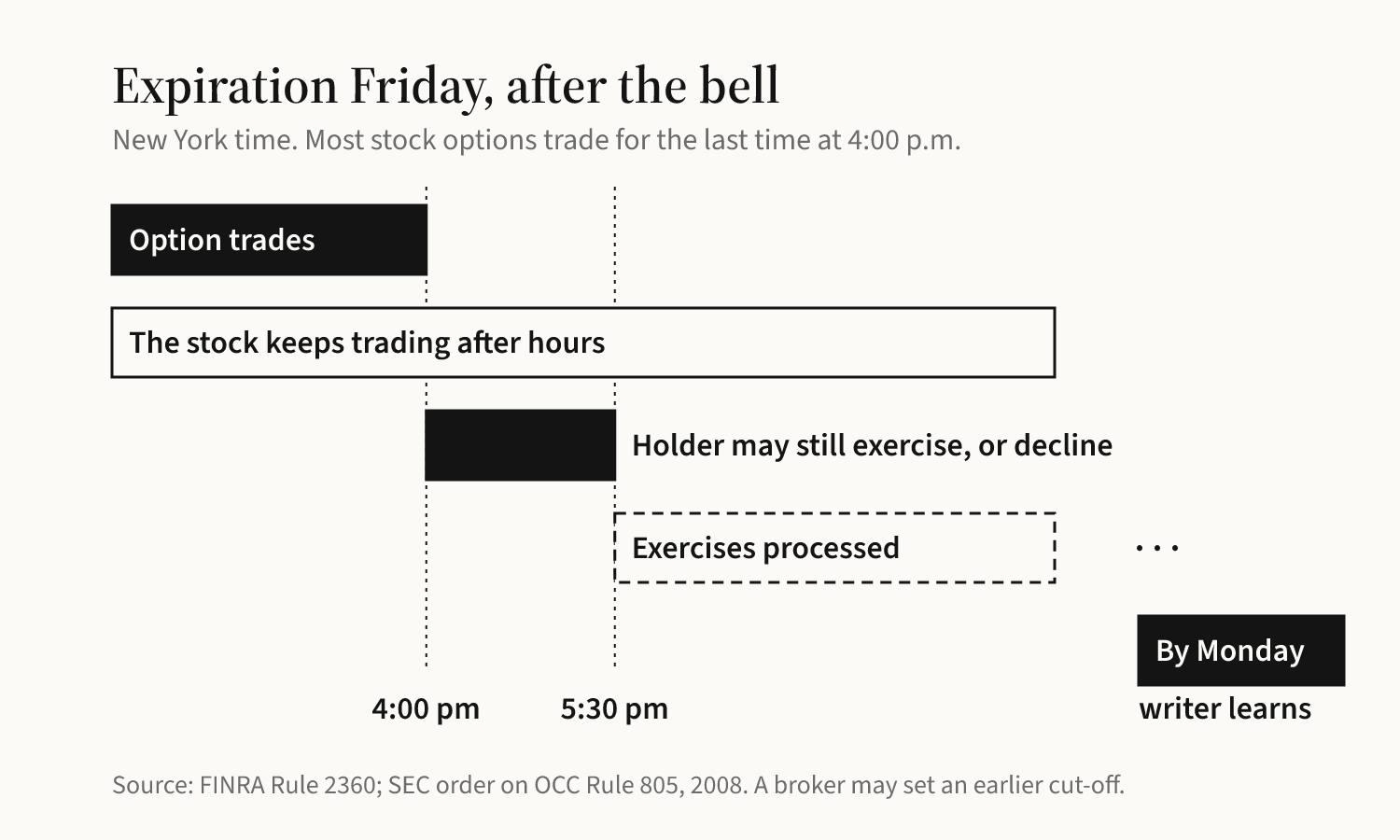
On its last day, a stock option can still be exercised for 90 minutes after the closing bell. News in that window can get an option that closed out of the money used against the person who sold it.
1. The words first
An option is a contract on 100 shares of a stock. A call gives its owner the right to buy them at a fixed price, the strike. A put is the same right to sell. Whoever owns an option is its holder. Whoever sold the option is its writer, and was paid for it up front. That payment is the premium.
When the holder uses the right, that is exercise. For the writer, the same event is assignment: the writer has to sell or buy the shares at the strike. An option is in the money when using it pays, which for a call means a stock above the strike and for a put a stock below the strike. An option that would not pay is out of the money.
2. The facts
| On expiration day | When or how |
|---|---|
| Trading in a stock option ends | 4:00 p.m. New York time, or 4:15 p.m. for a select group of busy names on Cboe |
| Automatic exercise | Any option in the money by a cent or more, against the 4:00 p.m. stock price |
| The holder’s last call to exercise, or to decline | 5:30 p.m., or a broker’s earlier cut-off |
| How a writer is picked | The clearing house picks a broker at random. The broker picks a customer by random draw or first in, first out. |
3. The close only sets a default
Each expiring option is measured against the stock’s 4:00 p.m. closing price. One that is in the money by a cent or more is exercised automatically. This is called exercise by exception. It is a rule of the Options Clearing Corporation, the clearing house that stands behind every listed US option. The threshold has been one cent since 2008.
FINRA, the regulator of US brokers, sets the deadline that matters. Its Rule 2360 gives holders “until 5:30 p.m. Eastern Time” to make “a final exercise decision to exercise or not exercise an expiring option.” That deadline works in both directions, through a form called a contrary exercise advice. With it, an option that closed out of the money can still be exercised, and an automatic exercise can be refused.
4. The stock keeps trading after the bell
After 4:00 the stock keeps trading in the after-hours session. Companies often release earnings or deal news in that window. The holder decides with after-hours prices that the option market never traded on. Once the last option session ends, at 4:00 or 4:15, the writer can no longer trade out of the option. The one tool left to the writer is the stock itself, in a thin after-hours market.
5. A worked example
A company closes at $49.80. A trader wrote one $50 call on it and collected a premium of $0.40 a share, or $40 for the contract. At the close the call is 20 cents out of the money. Under the default it lapses, and the writer keeps the $40.
At 4:20 p.m. the company agrees to be bought for $56 a share. After hours the stock trades at $55, a little under the offer. At 5:00 p.m. the holder sends an exercise instruction.
| The writer’s side, priced at $55 | Per share | Per contract |
|---|---|---|
| Must sell the shares at the strike | $50.00 | $5,000 |
| Cost of those shares at the after-hours price | $55.00 | $5,500 |
| Premium collected when the call was written | $0.40 | $40 |
| Result at $55 | −$4.60 | −$460 |
A writer who never owned the shares is now short 100 of them, which means owing shares that were never held. The −$460 is a mark at $55. The real result depends on where the stock trades when that short is closed, from Monday on.
FINRA’s own investor page on assignment has a put version. An investor wrote a $50 put and owned a $55 put on the same stock. The stock closed at $56, above both strikes, so both puts were out of the money. Then news after the bell sent the stock to $40. The holder of the $50 put could exercise it. The investor would then have to buy shares at $50 that traded at $40, a loss of $10 a share. The $55 put was worth $15 a share at $40, enough to cover that loss. It paid only if the investor sent an exercise instruction by the cut-off, because it had closed out of the money and would have lapsed on its own.
6. The writer hears last
The clearing house assigns each exercise to a broker at random. The broker then picks one of its customers who wrote an option of that series. Rule 2360 allows “first in-first out” or a random draw. On a Friday expiration, the writer may get the assignment notice over the weekend or on Monday morning.
A stock that closes right at the strike leaves the writer unsure whether an exercise is coming. Traders call that pin risk. It lasts through the weekend.
7. Friday 16 October
Friday 16 October 2026 is the third Friday of the month, the usual expiration day for monthly stock options. Most of them trade for the last time at 4:00 p.m. Their holders have until 5:30 p.m., or their broker’s earlier cut-off, to decide. The in-the-money test uses each stock’s 4:00 p.m. price.
Sources Cboe hours FAQ, FINRA Rule 2360, FINRA on assignment, SEC order on OCC Rule 805, 2008