Oil settled at minus $37.63 in April 2020 because the barrels had nowhere to go
On 20 April 2020, the US oil futures contract for May delivery settled at minus $37.63, its first price below zero since it began trading in 1983. It expired the next day. Anyone still holding it then had to take the barrels in Oklahoma, where the tanks were nearly full, so holders paid to get out.
TwiceOver
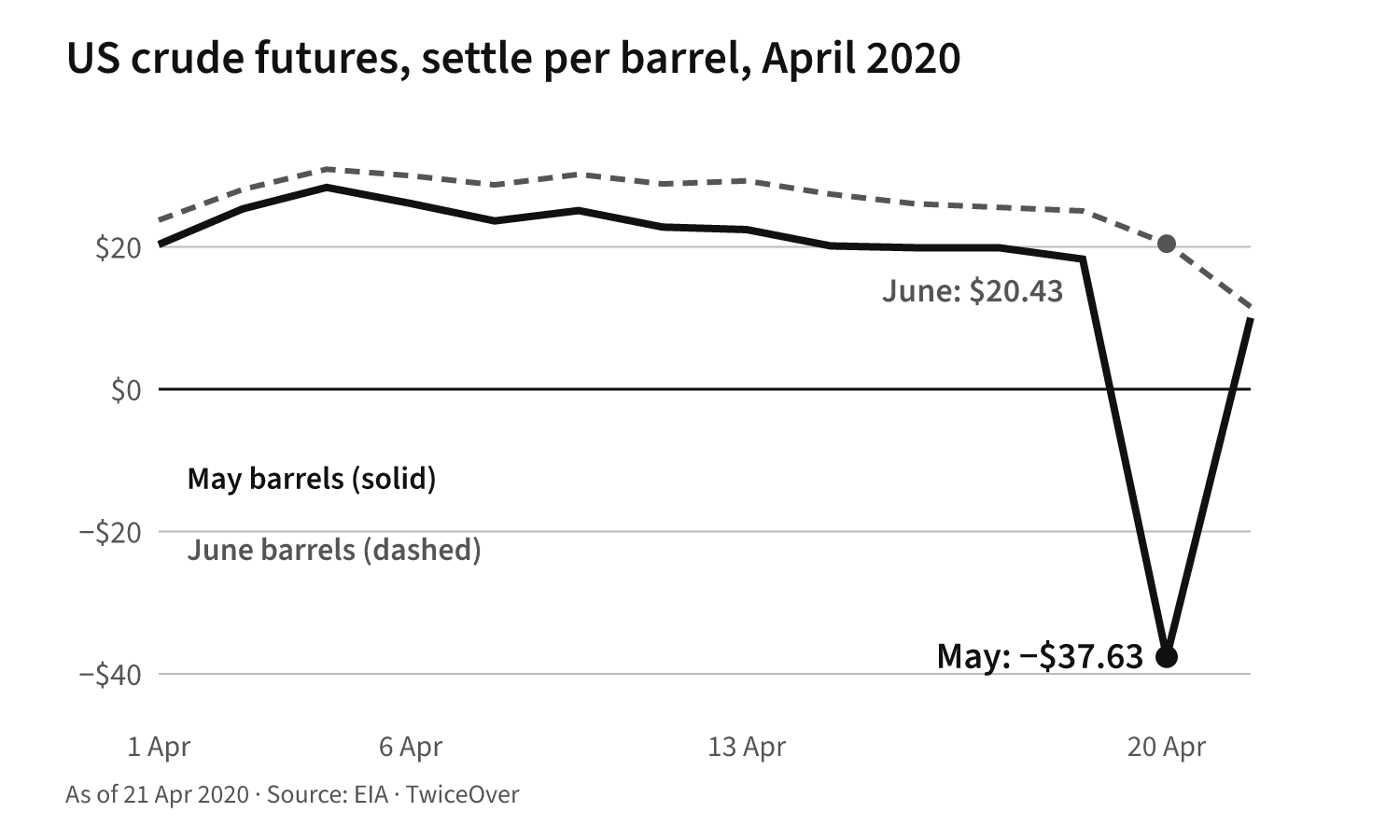
On 20 April 2020, the US oil contract for May delivery settled at minus $37.63 a barrel. The settle is the exchange’s official price for the day. The contract expired the next day, and anyone still holding it then had to take the barrels in Oklahoma, where the tanks were close to full. So holders paid other traders to take the oil off their hands.
The chart above follows the May barrels and the June barrels through 21 April. From 1 to 17 April the gap between them grew from $3.43 to $6.76, as May fell and June rose. On 20 April they were $58.06 apart.
1. What you held, and what it cost you
Say you hold one May oil contract on Friday 17 April. A contract is a promise to buy 1,000 barrels of US crude, delivered at Cushing, Oklahoma, during May. It settled at $18.27 that Friday, so the oil in it was worth $18,270.
On Monday it settled at minus $37.63. That is a fall of $55.90 a barrel. On 1,000 barrels you lose $55,900 in one day, about three times what the oil was worth on Friday.
Gains and losses on futures are paid in cash every night. That $55,900 is taken from your account after Monday’s settle, whatever the price does on Tuesday.
| Settle | Per barrel | One contract |
|---|---|---|
| Friday 17 April | $18.27 | $18,270 |
| Monday 20 April | −$37.63 | −$37,630 |
| Change in one day | −$55.90 | −$55,900 |
| Tuesday 21 April, last day | $10.01 | $10,010 |
Tuesday’s bounce of $47.64 a barrel paid $47,640 to whoever still held the contract. Few holders were left to collect it.
2. Why a price can go below zero
This futures contract ends in a delivery. The May contract stopped trading on Tuesday 21 April. Anyone still holding it then had to take 1,000 barrels a contract at Cushing in May, and find a tank to put them in.
Cushing could hold 75.8 million barrels, a figure from the Energy Information Administration (EIA). The US futures regulator, the Commodity Futures Trading Commission (CFTC), quotes it in its report on April 2020. On 17 April Cushing already held 59.7 million, the EIA’s weekly count shows. That left about 16 million barrels of room. The report adds that, according to some accounts, most if not all of the empty space was already committed.
At the start of the 20 April session, 108,593 May contracts were still open. That is 108.6 million barrels, almost seven times the room left at Cushing, had they all gone to delivery. About 95,000 of them were closed out that day, more than double the usual 41,096 on a contract’s second-to-last day. To get out, a holder had to find a buyer: a seller closing out, or a trader who could take the barrels or carry the contract to its end. From 2:08 p.m. on 20 April, in the run-up to the settle, those buyers were paid to do it.
3. Twenty minutes in the afternoon
The CFTC’s staff published their report about that day in November 2020, and it times the fall. The May contract opened the session on Sunday evening at $17.73. Between 2:08 and 2:28 p.m. New York time on Monday it went from $0 to minus $39.55. It touched minus $40.32 at 2:29.
The settle did not come from outright May trades. The exchange, NYMEX, averaged the trades of May against June between 2:28 and 2:30 p.m. That put May $58.06 under June. June settled at $20.43, so May settled at $20.43 minus $58.06, which is minus $37.63.
| 20 April session | May oil, per barrel |
|---|---|
| Sunday 19 April, 6:00 p.m., the open | $17.73 |
| 2:08 p.m. | $0 |
| 2:28 p.m. | −$39.55 |
| 2:29 p.m., the low | −$40.32 |
| 2:28 to 2:30 p.m., the settle | −$37.63 |
4. June oil was worth $20.43 the same day
June oil was the same crude, at the same place, one month later. The June contract settled at $20.43 on 20 April. May traded $6.76 under June on Friday and $58.06 under June on Monday. That discount is what a barrel delivered in May lost against the same barrel a month later. In April 2020 it reflected how little tank space was still free.
Most holders had moved out during April. Open May contracts peaked at 634,727 on 2 April, the report says. Funds that track oil prices, exchange-traded funds among them, moved their positions to June during the month. By the open on 20 April, only 4.5% of all open contracts in this oil future were for May.
Smaller traders were still in. Traders below 350 contracts are not reported to the CFTC one by one. At the start of that session they held 15.3% of the May contracts on the buying side. Over the prior year, their share on the day before expiry averaged 10.3%.
When May oil stopped trading on 21 April, 2,427 contracts were left, fewer than the prior year’s average of 2,815. Oil companies the CFTC classes as producers held every contract left on the buying side. Those 2,427 contracts are 2.4 million barrels, a small fraction of the 16 million barrels of tank space empty on 17 April. The price was made on Monday by holders paying to avoid ever needing that room.
5. The option models broke too
An option’s price is often worked out with a formula. The standard ones, Black-Scholes and its version for futures, take the logarithm of the price. Zero and negative numbers have no logarithm, so those formulas cannot price an option on oil at or below zero.
CME, which owns NYMEX, had prepared for negative prices. On 8 April it told its clearing members it would give one day’s notice before letting option prices and strike prices go negative. That day’s notice was meant to give firms time to switch to another formula, the Bachelier model, which works without logarithms.
6. What it teaches today
Near a contract’s last day, its price is a price for barrels at one place in one month. When that place runs out of room, the price can fall through zero.
On 16 October 2026 Cushing held 27.6 million barrels, the EIA’s weekly count shows. That is less than half the 59.7 million of 17 April 2020. A barrel bought for delivery there cost $107.89 on 20 October, the EIA’s spot price. Low stocks at Cushing and oil above $100 read as a market short of barrels, the reverse of April 2020.
The gauge from 2020 is still there to read: how far the expiring month trades under the next one in its last days. In April 2020 that discount widened fast as the tanks filled.
Stock-option expiries have their own last-day risk, in the post on an option writer’s riskiest 90 minutes. Selling in a stock crash is counted seller by seller in the post on the 1987 crash, where four sellers made 14% of the day’s stock sales.
Sources CFTC staff report, 2020, EIA oil futures prices, EIA Cushing stocks, EIA oil spot price, CME notice, 8 Apr 2020