Michael Burry says his $912 million bet against Palantir cost $9.2 million
A fund's quarterly holdings report lists an option at the value of the shares behind it. So Burry's Palantir puts showed as $912 million. He said he paid $9.2 million for them.
TwiceOver
Michael Burry’s fund reported puts on $912 million of Palantir shares in November 2025. Burry said the puts cost him $9.2 million. A fund’s holdings report values the shares an option covers, at their price on the quarter’s last day.
You will meet the same gap on any option line in any fund’s report. Scion Asset Management filed its list for the quarter that ended on 30 September 2025. The headlines that week said Burry had bet $1.1 billion against Palantir and Nvidia. Within two weeks of the filing, he put his own number on it on X.
1. The two numbers
A put is the right to sell a stock at a set price, the strike. One standard contract covers 100 shares.
| Palantir puts | |
|---|---|
| Contracts | 50,000 |
| Shares they cover | 50,000 × 100 = 5,000,000 |
| Share price the report used | $182.42 |
| What the report shows | 5,000,000 × $182.42 = $912,100,000 |
| Price Burry said he paid | $1.84 a share, or $184 a contract |
| What he said he paid | 50,000 × $184 = $9,200,000 |
The cost is about 1% of the reported value. Burry’s post on X:
“So I spent $9,200,000, Not $912,000,000.”
The puts, he wrote, gave him the right to sell Palantir at $50 in 2027.
2. Why the report shows the bigger number
The report is Form 13F. A manager with $100 million or more in US-listed stocks and similar securities files one each quarter. It lists what the fund holds on the quarter’s last day, and it is due within 45 days.
The form’s own instructions set how an option goes in. Most of the columns, value included, are filled in
“in terms of the securities underlying the options, not the options themselves”
So a put line carries the value of the shares it covers, at the closing price on the quarter’s last day.
The instructions count differently for one job. To decide whether a manager is big enough to file at all, they count only the value of the options themselves. That figure never reaches the public table. It is the options’ own market value, which can differ from what Burry paid whenever he bought them.
3. What the puts could ever pay
On the day they expire, puts struck at $50 are worth nothing if Palantir is above $50. Before then they gain value as the stock falls, even from $182 to $120. At the report’s $182.42, the stock had to fall 73% to reach the strike. The $9.2 million paid was the most the position could lose.
Here is what the 50,000 contracts are worth on the day they expire, at a few Palantir prices.
| Palantir at expiry | What the puts are worth | Against the $9.2 million paid |
|---|---|---|
| $182.42 | $0 | down $9.2 million |
| $50.00 | $0 | down $9.2 million |
| $48.16 | $9.2 million | even |
| $40.00 | $50 million | up $40.8 million |
| $25.00 | $125 million | up $115.8 million |
| $0 | $250 million | up $240.8 million |
Below $50, each row is ($50 − the price) × 5,000,000 shares. The bottom row is the ceiling. If Palantir went to zero, the puts would pay $250 million. The $912 million in the report was never a sum they could reach.
4. The whole filing, counted the same way
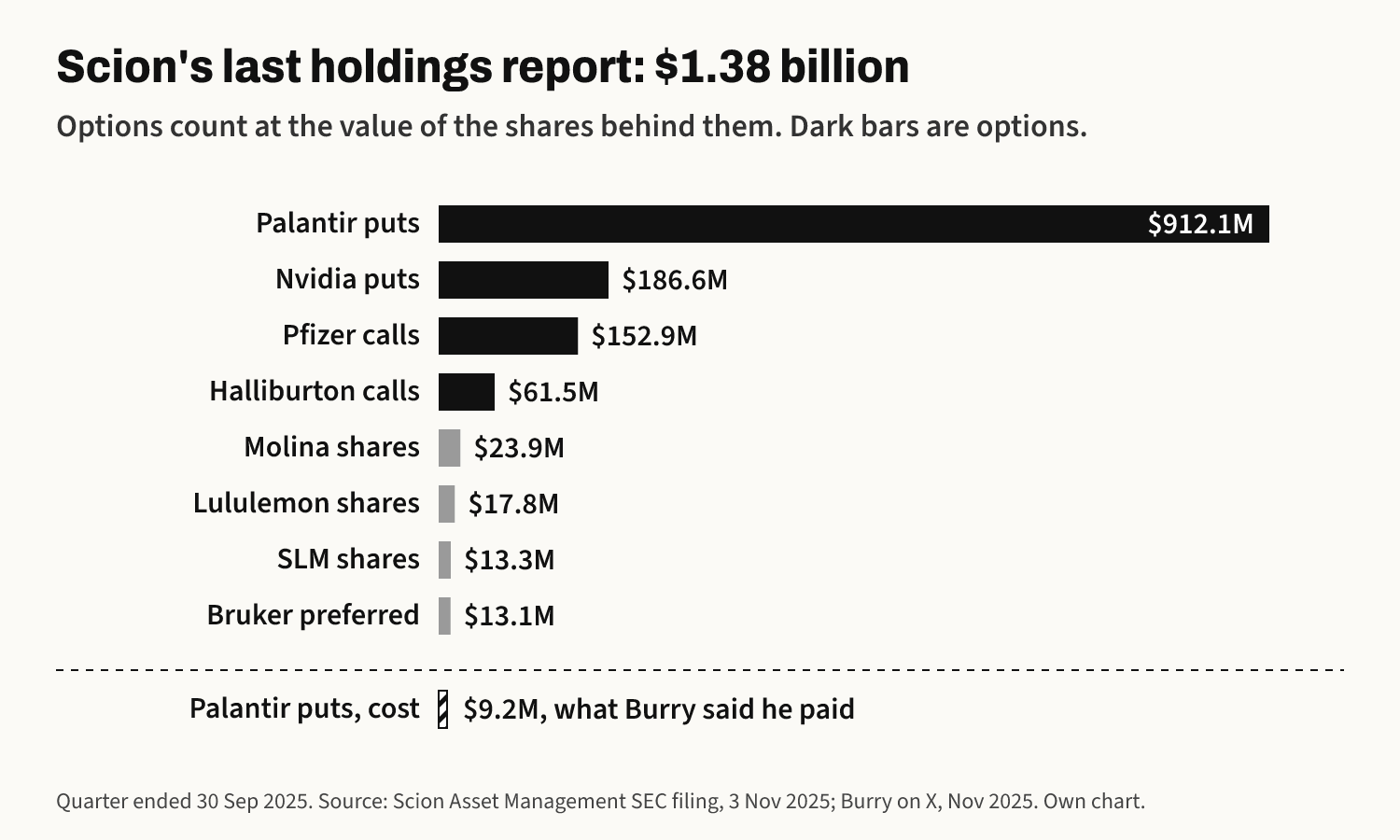
Scion’s report had eight lines worth $1,381,198,076 in all. Four of them were options. The chart shows each line at the value the report gives it.
| Line | Shares | Reported value |
|---|---|---|
| Palantir puts | 5,000,000 | $912,100,000 |
| Nvidia puts | 1,000,000 | $186,580,000 |
| Pfizer calls | 6,000,000 | $152,880,000 |
| Halliburton calls | 2,500,000 | $61,500,000 |
| Four lines held outright: Molina, Lululemon and SLM shares, and Bruker preferred shares | 753,388 | $68,138,076 |
The four option lines come to $1,313,060,000. That is 95% of the total, and every dollar of it is share value. The Palantir and Nvidia puts add up to $1,098,680,000, which is where the $1.1 billion headlines came from.
The calls are counted the same way. A call is the right to buy at the strike. The Pfizer line values 6,000,000 shares at $25.48 each, Pfizer’s closing price on 30 September. Like the puts, the calls carry no strike, expiry or price paid in the report.
5. What a holdings report leaves out
The SEC’s answers to filers name two things that stay off the form.
- Short sales. A fund does not report shares it has sold short.
- Options it sold. A fund reports only options it holds. An option it wrote is left out.
The form’s columns and its report date add two more.
- The terms. There is no column for a strike, an expiry or a cost.
- Anything after the quarter’s last day. Scion filed on 3 November, 34 days after the date the report describes.
So a put line tells you a fund held a position that gains if that stock falls, on one day. What the fund paid has to come from another source. Here it came from Burry’s own post on X. As of October 2026, this is the last holdings report Scion has filed with the SEC.
6. Reading other funds’ reports
Every other fund’s report for the quarter that ended on 30 September 2026 falls due by mid-November. On any option line, divide the value by the shares. You get the stock’s closing price on the quarter’s last day. Divide the shares by 100 for the number of standard contracts. Neither figure shows what the fund paid.
For more on what options are priced to do, read how often earnings moves stayed inside the implied move and what can happen to an option after expiration day’s close.
Sources Scion holdings filing, SEC Form 13F instructions, SEC Form 13F FAQ, Michael Burry on X