Silence Therapeutics (SLN) closed 42 cents under Merck KGaA's $20 offer: 38 cents is interest, 4 cents is deal risk
Silence Therapeutics closed Monday at $19.58 against Merck KGaA's $20.00 cash offer. The same $19.58 in a Treasury bill earns about 38 cents by the end of March, so the market asks about 4 cents for the risk that the deal fails.
TwiceOver
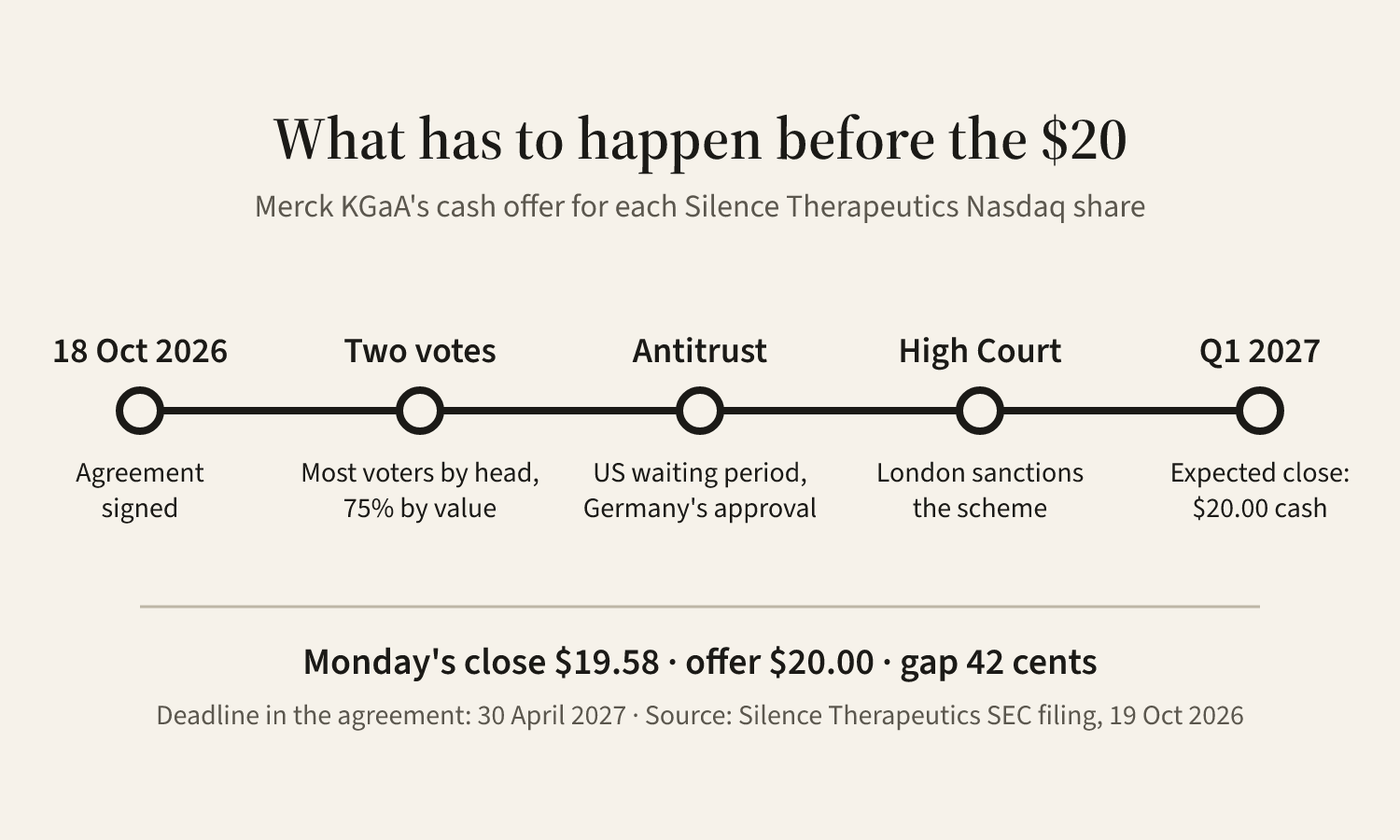
Silence Therapeutics closed Monday at $19.58, 42 cents under the $20.00 in cash that Merck KGaA, the German drug group, has agreed to pay for each Silence share listed on Nasdaq. The same $19.58 put in a six-month Treasury bill would earn about 38 cents by the end of March. That leaves about 4 cents for the risk that the deal breaks, so the price treats it as close to done. The company’s own filing lists what still has to happen first.
1. Monday, in five lines
| Silence Therapeutics on Nasdaq | |
|---|---|
| Friday 16 October close | $8.68 |
| Monday 19 October close | $19.58, up 125.6% |
| Monday’s range, low to high | $19.56 to $19.61 |
| Shares traded | 71.9 million on Monday, 1.1 million on Friday |
| Merck KGaA’s offer | $20.00 in cash |
Figures are as of Monday’s close. The agreement was signed on Sunday 18 October and announced on the Monday, and the whole day traded inside five cents. Under a cash offer, the price moves with the odds of the deal and the time left to closing.
The buyer, Merck KGaA, is based in Darmstadt. Merck & Co., of New Jersey, is a different company.
2. What the 42 cents pays for
The gap between a target’s price and the offer is called the spread. Buying at $19.58 and collecting $20.00 earns 2.1%. Funds that buy targets after a deal is announced and wait for the cash run a trade called merger arbitrage, and the spread is their whole pay.
That pay arrives only at closing, and until then the money is tied up. The press release says the deal is “expected to close in the first quarter of 2027.” The six-month Treasury bill, the one closest to that date, yielded 4.38% on Monday.
| If the $20 arrives on | Days from Monday | What a Treasury bill earns on $19.58 | Left of the 42 cents |
|---|---|---|---|
| 31 March 2027, the end of the first quarter | 163 | $0.38 | $0.04 |
| 30 April 2027, the agreement’s deadline | 193 | $0.45 | −$0.03 |
The bill’s interest is worked as simple interest at 4.38%. The bill matures in mid-April, so the second row stretches its rate by a few weeks. On the first row, 4 cents a share is all the market asks for carrying the risk that the deal breaks. If the deal runs to its April deadline, the spread pays less than the bill, so Monday’s buyers are counting on the first-quarter date.
If the deal broke, the price could fall back toward Friday’s close of $8.68, which is $11.32 under the offer. The market is setting the odds of that fall close to zero.
3. What the filing says still has to happen
Silence filed the deal with the SEC on 19 October, on a Form 8-K. That is the short report a US-listed company files when something major happens, and this one has the full transaction agreement attached. The filing lists eight conditions. The first is the vote:
approval by the Company’s shareholders of the Scheme of Arrangement by a majority in number representing not less than three-fourths (75%) in value of the members […] present and voting
Silence is a company of England and Wales, so it is being bought through a scheme of arrangement. That is a procedure under the UK Companies Act. Shareholders vote on it, a court sanctions it, and from then on it binds every holder, including those who voted against. The vote has two tests. Most of the holders who vote, counted by head, must approve. Those approving must also hold at least 75% of the shares voted. A second meeting must then pass a special resolution, which also needs 75% of the votes cast.
The other seven, in the filing’s order:
- The US antitrust waiting period ends, and the deal is cleared under German antitrust law.
- Each side has kept its promises under the agreement.
- Each side’s statements in the agreement prove accurate.
- The High Court of Justice of England and Wales sanctions the scheme.
- No law or court order blocks the deal.
- Each side delivers its closing papers.
- Nothing happens to Silence that counts as a “Company material adverse effect.”
Holders of about 14% of the votes have signed agreements to vote yes. The filing also says: “The consummation of the Transaction is not subject to any financing condition.”
Each Silence share on Nasdaq is an American depositary share. A bank holds three ordinary Silence shares behind each one. The agreement pays $6.6667 for each ordinary share, which is where the $20.00 comes from.
4. Only Silence owes a fee
The agreement’s “Termination Payment” section names one payer, Silence, and no fee for Merck KGaA. Silence owes Merck KGaA $13 million if any of these happens:
| When Silence owes the $13 million |
|---|
| The Silence board changes its recommendation, and Merck KGaA ends the deal |
| Silence ends the deal to accept a better offer |
| The deal fails on the deadline, on the vote or on a breach while a rival bid is public, and within 12 months Silence agrees another sale that is completed |
The press release puts the deal’s equity value at about $1.3 billion, so the fee is about 1% of it. At $20 a share, that is about 20 cents for each Nasdaq share. The fee matters most in the second case: Silence would owe it on leaving for a higher bid.
5. Why a London-based company can agree to that fee
Silence’s offices are in London. The agreement opens with a note from the UK Takeover Panel, the body that runs Britain’s takeover rules. For a company like Silence, the Panel’s test is where the company is run from. The Panel “does not consider that Company has its place of central management and control in the United Kingdom.” The Panel’s reason is where Silence’s directors live. The next line follows from it:
accordingly, the Takeover Code does not apply to Company or the Transaction
That matters for the fee. Rule 21.2 of the Takeover Code bars a target from any “offer-related arrangement” with a bidder unless the Panel consents. The rule names the “inducement fee arrangement” as one such arrangement. The Panel says the rule has stood in its present form since September 2011. Outside the Code, the size of the fee was for the two companies to agree.
6. What settles it
No meeting or court date is set yet. Silence says it “intends to file a proxy statement” with the SEC, a document that will carry the meeting dates and the explanation the UK court process requires. The two votes come next, then the court hearing. The antitrust reviews run alongside, and the agreement’s deadline is 30 April 2027.
Deal news can also land after the closing bell. Our post on what happens to an expiring option after the bell works through a $56 offer that arrives at 4:20 p.m. Short-term rates have their own calendar, and our post on September’s inflation figures has the next date that matters for them.
Sources Silence Therapeutics SEC filing, Transaction agreement, US Treasury bill rates, Stock Analysis, Takeover Code Rule 21.2